


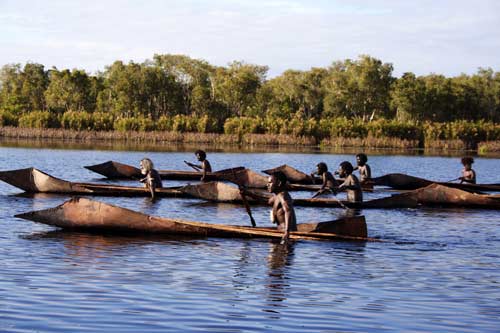
I first noticed the director Rolf de Heer when I saw his powerful Western The Tracker. That movie confronted head-on the colonial legacy that's plagued relations between whites and aborigines in Australia. Four years later, de Heer decided to leap over those post-colonial difficulties by collaborating with an aboriginal village and bringing their stories to the big screen. The result is the delightful Ten Canoes.
The film actually uses a double framing device. The narrator (David Gulpilil from Rabbit Proof Fence and The Tracker) tells a story about an older man with three wives. When his younger brother takes a fancy to one of those wives, the older man tells an ancient tale that mirrors the first story. De Heer shows the two stories in parallel, which might seem confusing, but he makes things beautifully clear by using color for the ancient tale and slightly over-exposed black-and-white photography for the more contemporary one.
What follows is a lovely film about storytelling and aboriginal life. From the opening gorgeous helicopter shot over the plains and swamps to the way each character is introduced with a head-on closeup, de Heer obviously wants to introduce the audience to this land and culture and let them speak for themselves. The movie begins with Gulpilil intoning, "Once upon a time," but then he laughs and remarks, "It's not your story, it's my story," cheekily poking fun at the Western fairy tale tradition to let us know "his" tales might be a bit different.
The narratives are relatively simple, and as Gulpilil himself points out, they take a while to get to their destination. My suspicion is that in a less exotic setting, many moviegoers would find themselves bored, but their culture is so different from ours that there's always something to notice. Furthermore, the cinematography, both brilliant color and striking black-and-white, is stunning. And the dialogue is comically earthy with jokes about farting and penis size, a reminder that certain movie conventions cross any cultural boundary.