


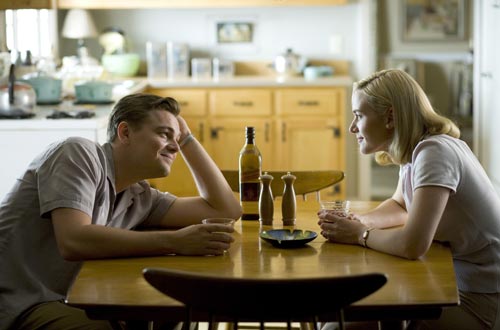
Much has been made of the fact that Revolutionary Road reunites Kate Winslet and Leonardo DiCaprio for the first time since they swept us off our feet in Titanic. But if elegant romance is what you’re looking for here, you’ve come to the wrong time period. Even Rose and Jack’s passion couldn’t have survived the ‘50s.
At least that’s the message most audiences will take away from this bleak drama. The movie is based on Richard Yates’s 1961 novel, one of the first to pinpoint the despair behind the happy picket fences of suburbia. Unfortunately, that theme has been beaten to death in the last 40 years, so one more tale of people in gray flannel suits and pretty cotton dresses suffering quiet desperation feels dated, if not irrelevant.
Fortunately, if the story needs to be retold (and maybe, with all the politicians pining for the values of the ‘50s, it does), it could do far worse than a production of this caliber. Kate Winslet gives a brilliant performance as the wife who convinces her husband to drop everything, move to Paris, and escape “the hopeless emptiness of the whole life here.†Leo doesn’t quite have the gravitas to match his on-screen wife, but he powerfully conveys what happens when a man looks around and realizes his dreams have no hope of coming true. Michael Shannon is great as a mentally unstable young man who still perceives more than anyone around him, though that character was a cliche the moment Yates wrote him. Best of all, though, is Kathy Bates as a nosy neighbor. The inflection she gives to a simple “Yoo Hoo†says more about stifling suburbia than any dialogue ever could.
Even better than the acting, however, is the film’s production design and art direction (courtesy of Kristi Zea, Teresa Carriker-Thayer, John Kasarda, and Nicholas Lundy). Their use of browns and beiges, grays and blues is both gorgeous and thematically potent. The relatively open vistas of the husband’s office contrast sharply with the divided rooms of the couple’s house. And Roger Deakins, one of contemporary film’s finest cinematographers, complements it all with gorgeous long shots and perfect camera placement. If you want to remind yourself that suburbia is America’s hell and conformity its defining characteristic, then this is the movie for you.