Plastic Podcast

The venerable and exceedingly intermittent Plastic Podcast, which has outlived the two blogs with which it was intertwined, and whose audio archives were difficult to ...

The Plastic Podcast

An audio program about movies. Listen with your iPod or computer.

Plastic Podcast

The venerable and exceedingly intermittent Plastic Podcast, which has outlived the two blogs with which it was intertwined, and whose audio archives were difficult to ...

Other Recent Podcasts

Feeds

Favorite Recent Tweets

via Twitter

About

Daily Plastic is a Chicago-based movie blog, a collaboration between Robert Davis and J. Robert Parks, the same pair who brought you the wearable movie tote, the razor-thin pencil pocket, and that joke about aardvarks. If you know the whereabouts of the blue Pontiac Tempest that was towed from the Plastic Parking Lot on the evening of August 7th, 2008, or more importantly if you've recovered the red shoebox that was in its trunk, please contact us at your earliest convenience.

Davis was the chief film critic for the late, great Paste Magazine (which lives on now as a website) from 2005 through 2009, and he counts this interview with Claire Denis among his favorite moments. Every once in a while he pops up on Twitter. He's presently sipping puerh in Chicago, even at this hour. Meanwhile, Parks, whose work has appeared in TimeOut Chicago, The Hyde Park Herald, and Paste, is molding unsuspecting, college-aged minds in the aforementioned windy city. Media types are warned to stay clear of his semester-sized field of influence because of the distorting effects that are likely to develop.

The © copyright of all content on Daily Plastic belongs to the respective authors.

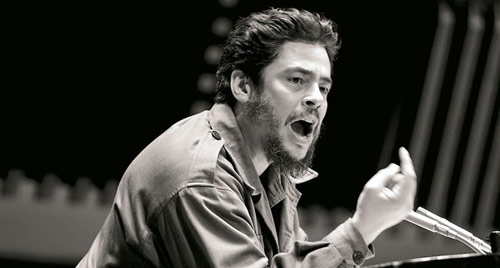
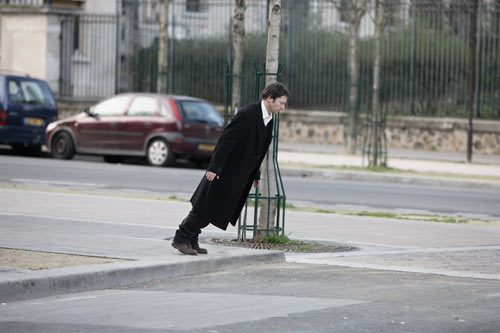
Benecio Del Toro as Che Guevara in Steven Soderbergh’s Che

I wake up early this morning. Not just because it’s a 9 a.m. screening, but because it’s a 4+-hour film at the Ryerson, by far my least favorite theater used in the festival. The Ryerson isn’t actually a movie theater for most of the year; it’s a college auditorium. So the seats are narrow, there isn’t much leg room, and the rake (the change in elevation) is flatter than a traditional theater, much less stadium seating. What this means is that the only way I’m going to be even remotely comfortable for Steven Soderbergh’s Che is if I get an aisle seat. So I get in line an extra hour early. At least it’s not raining.

The film is a surprisingly straightforward bio-pic of Ernesto ‘Che’ Guevara. Like Soderbergh did in Traffic, he uses various film stocks and color schemes to separate the various storylines: Che in Mexico before heading to Cuba, Che in the jungles and hills of Cuba, Che speaking at the United Nations several years later. But once you get used to that framework, the story moves through its paces. Only a faux-overture feels the least bit postmodern.

Those unfamiliar with the Cuban Revolution will find much to learn here, though anyone relying on a movie for that kind of information is asking for superficiality. And while the movie isn’t out to make Che into some kind of saint, it doesn’t do anything to puncture the balloon of reverence many people feel for him. Benicio Del Toro is fine in the lead role, though I was surprised at how low-key his performance is. It’s certainly not Oscar-bait, for which I guess I should be grateful. And Soderbergh knows how to edit his footage together, keeping everything moving forward, never letting the audience lose track of the story.
Continue Reading

Jean-Claude Lother / Why Not Productions / IFC Films
Arnaud Desplechin's A Christmas Tale

Every festival goer makes his own festival and finds her own themes. Half way through this year's Toronto International Film Festival -- which wrapped up on Saturday -- it was clear that I'd accidentally scheduled movies about families.

Then in the second half, film after film continued to round out this theme, whether it's because I was looking for it or because a coin flipped seven times will sometimes produce seven heads. (It was probably a little of both.) I'd have grown tired of the family reunions and blow-ups if the films hadn't been so honest and true, many of them not only exploring interesting subject matter -- deeply and personally -- but also exercising film as an art form. Denis's musical minimalism and Desplechin's cinematic vortex, each in its own way, found new ideas in a century-old toolbox. All of my favorites were fresh takes on the familiar, so every time a black sheep would darken the family's door or a shoebox of photos would appear from beneath the bed, I'd smile instead of roll my eyes at the repetition.

In that box of photos, Darren Aronofsky's wrestler finds a photo of his daughter and turns it over to find a list of phone numbers, all but the last one struck-through. The daughter in Claire Denis's 35 Shots of Rum finds an old letter that concerns her. The house in Arnaud Desplechin's A Christmas Tale has pictures of the black sheep's first wife, the mysteriously-named Madeline, now dead. Instead of a shoebox full of photos, Olivier Assayas's film, Summer Hours, has an entire house full of keepsakes, and Assayas considers his characters by measuring their affection for these objects: the stuff of museums and dollars on one end, mementos of sentimental value in the middle, and things that will remain in daily use forever, the past repurposed for youth.

Continue Reading

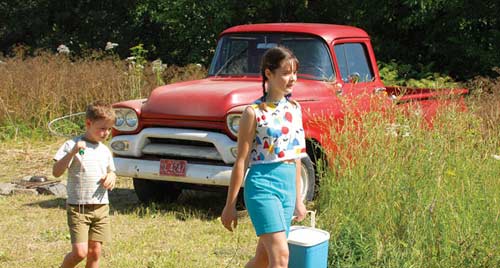
Hugo St-Onge-Paquin and Marianne Fortier star in Lea Pool’s My Mom’s at the Hairdresser

I first noticed director Lea Pool with her 1999 feature Set Me Free, about a girl on the edge of adulthood. Pool’s ability to portray and work with adolescents was powerful. So when I heard her latest film, My Mom’s at the Hairdresser, also dealt with children, I slotted it into my schedule. I’m glad I did, as she again obtains wonderfully naturalistic performances from her trio of stars.

In this case, the characters are three siblings--the oldest Elise, middle Coco (a boy), and youngest Benoit--starting summer in idyllic Quebec in 1966. Elise jumps off the school bus barefoot, ready to get going, Coco has plans to build his own go-cart, and Benoit ... well, Benoit is asking a lot of questions at the age of 5 or 6. The first third of the film is wonderfully comical, as Pool, working from a novel by Isabelle Hebert, captures how children play and interact. But the movie also realizes that children understand more than we give them credit for, that they watch adults and learn, in both good ways and bad.

Continue Reading

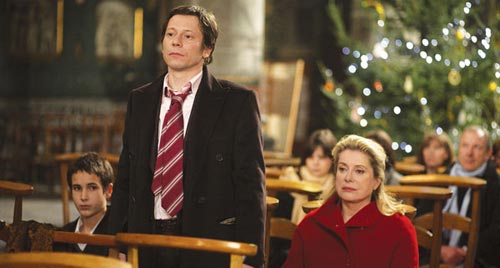
Mathieu Amalric and Catherine Deneuve in Arnaud Desplechin’s A Christmas Tale

Fridays are normally reserved here at Daily Plastic for new reviews. And unlike the last few weeks when almost nothing good was released, there are some interesting possibilities for today. But we’re having too much fun in Toronto to wax poetic about Burn after Reading and Righteous Kill. But to make it up to you, we’re posting TWO days of TIFF reflections. Cuz you really didn’t want to work today anyway, did’ya? This is Day 7, while Day 6 (due to the brilliance of blogging technology) is farther below.

Today was a strong day, with three winners out of five and only one bad film. The best was Arnaud Desplechin’s A Christmas Tale. Festival co-director Piers Handling introduced it as a movie “about a dysfunctional family par excellence,” and he’s exactly right. The mother Junon (a wonderfully cold Catherine Deneuve) is openly hostile to her son Henri (Mathieu Amalric, delightfully unstable), whom she blames for her eldest son’s death at the age of six. No matter that Henri was still in diapers at the time. Elizabeth (Anne Consigny) detests Henri as well and even went so far as to banish him from the family. Elizabeth’s son Paul is in the midst of a nervous breakdown. And I could go on and on. Only the patriarch Abel (Jean-Paul Roussillon as the doughy moral center of the film) and the youngest son Ivan seem to get along with everyone, but maybe not.

Continue Reading

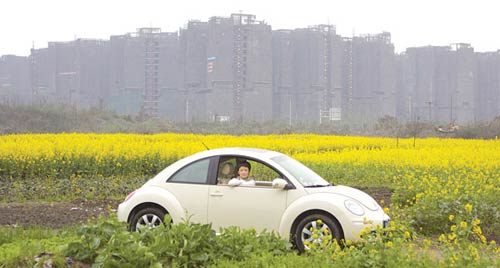
A shot from Jia Zhang-ke’s 24 City

I’ve realized over the last couple years that sold out doesn’t always mean sold out at TIFF, and I’m not just talking about the possibility of rush lines. Tickets are reserved in advance for publicists and other festival guests, but obviously not all of those seats are needed. So often by the fourth or fifth day, when TIFF has a better perspective on what it requires, it releases more tickets. Furthermore, the lines to exchange tickets are often significantly lighter by Monday than they are over the weekend. So today I walked into the box office at 9 a.m., strode confidently to the open agent, and proceeded to get all four movies for which I had been shut out of in the lottery. Woo hoo!

The morning just keeps getting better when I meet up with Ken Morefield for a delicious breakfast at Cora’s, which includes lots of discussion about college teaching, academic writing, and of course movies. And then we’re off to one of the more difficult films of the fest. But I’ll save that for the end.

• • •

The Chinese director Jia Zhang-ke made one of my favorite films of the decade with Still Life/Dong. Though those are two different movies, I saw them both at TIFF ’06, and their similar subject matter makes them a natural pairing. He followed that up with last year’s Useless, which was interesting and well made but didn’t scale anywhere near the heights of his previous work. Even still, I had high hopes for his latest, 24 City.

Continue Reading

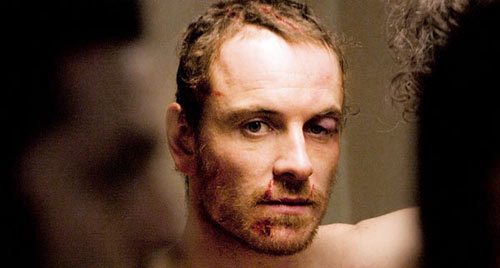
Michael Fassbender stars as Bobby Sands in Steve McQueen’s Hunger

You’d think that having done Toronto for six years now that I’d have it all figured out. But somehow I forgot what five-film days are like and scheduled three of them in a row. Not smart by me. So I wake up this morning tired. No, exhausted. Yet the first movie is one of the more acclaimed films to come out of Cannes. How can I pass that up? So I roll out of bed for a 9 a.m. screening. Somewhere the scheduling gods are chuckling.

In a more miserable world, the movie would stink, but not this time. Hunger earns its praise with a strong, unusual narrative and striking directorial choices. The movie is about Bobby Sands’s hunger strike in 1981 when he was imprisoned for crimes he committed with the Irish Republican Army. Interestingly, though, Sands is rarely onscreen for the first third of the movie. Instead, director Steve McQueen (no, not that Steve McQueen) focuses on a British prison guard, then two other I.R.A. prisoners. In this way, he conveys what a horrible situation this is for prisoners and guards alike.

This also removes every pitfall over which bio-pics often stumble. This isn’t hagiography. It’s also not an attempt to encapsulate all of Sands’s life or even find great inspiration in his deeds. Instead, it’s a capsule of the bitter conflict between the I.R.A. prisoners, who demanded political status and the rights that went with that, and the British government, who considered them terrorists and refused to give in. And by focusing exclusively on the prison, McQueen shows how those two positions created a cycle of violence that had ramifications well beyond those cells.

Continue Reading

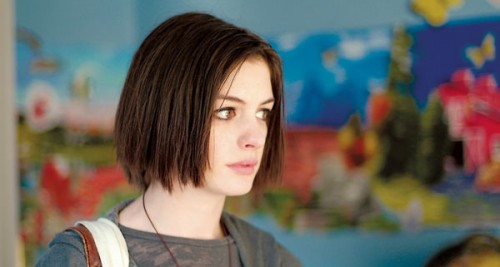
Anne Hathaway as Kym in Rachel Getting Married (Demme)

With three more days left in the festival, my sense of the films I've seen -- as a whole -- is starting to take shape. I'm posting very quick reactions at Twitter (140 characters or fewer), and I'll be posting about the best English-language features shortly at Paste; I'll put a link here at Daily Plastic.

But looking at the whole lot, if I list them in order, they'd probably break out as shown below.

Some films take more time and consideration than a festival allows, and many of these could grow or shrink in my regard as I noodle on them. I've only been able to see one of these films a second time (35 Shots of Rum), for instance. Also, I've broken the list into sections, and within these broad swaths there's no sense in fine-tuning. I mean, is Rachel Getting Married better than Wendy and Lucy? Or is The Burning Plain worse than Burn After Reading? Could be, could be, burn 'em both, burn 'em both. But there's no time for such nit-picking today.

Continue Reading

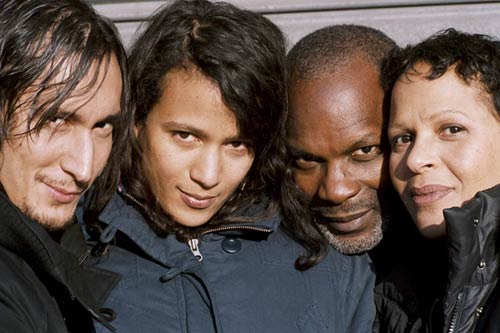
We like this photo, but it might be time to find a new one. Publicist?

Claire Denis’s 35 Shots of Rum is one of those films that I hesitate to say too much about for fear of breaking the spell. It’s a marvelous story of a father, a daughter, and ... I don’t know. Friends. Lovers. Co-workers. It’s about a place. It’s about growing old. Falling in love. Family, both the blood kind and the neighborly ones. It’s about Life. That may be a cliche with some movies but not this one.

The story is obliquely told, Denis assuming that we can keep up, that the actors are good enough to convey with just small glances and smiles what we need to know. Of course they are. This creates moments of incredible beauty and power, as it dawns on us what’s about to happen or maybe what happened twenty years before, as we fully understand what we only partly guessed.

Continue Reading

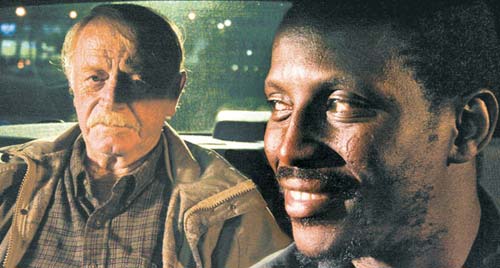
Red West and Souleymane Sy Savane in Ramin Bahrani's Goodbye Solo

I unfortunately feel a bit of pressure early on in a festival if I haven’t seen any great movies yet. I start to wonder if I’m expecting too much, given the time and money it’s taken to get here. I ponder if seeing five movies in one day is conducive to fair judgment. And then I see a movie like Goodbye Solo.

Directed by Ramin Bahrani, who also made the fantastic Chop Shop, Goodbye Solo is about a friendly cabbie from Senegal living in Winston-Salem, NC. As the movie opens, a curmudgeonly old man (a wonderful stoic performance from Red West) has offered Solo a large amount of money to take him on a journey in a couple weeks to the top of a mountain. Solo’s playful curiosity about the trip’s purpose soon reveals that the man plans on committing suicide. Solo being who he is, he decides to persuade the man not to go through with it. How? By drawing the old man into his own life.

What follows is an exquisite story, with rich characters, spot-on dialogue, and beautiful pace. Unlike other movies I’ve seen at the festival, where I wondered why certain scenes hadn’t been left on the cutting floor, every moment of Goodbye Solo is integral to the story, every scene propels the narrative forward. Grounding it all is a star-making (and Oscar-winning, if there were any justice) performance from Souleymane Sy Savane, who is absolutely charismatic as a man persistently trying to save another man. But Bahrani has such a way with actors that the non-professionals, especially the young Diana Franco Galindo as Solo’s stepdaughter, keep up as well.

Continue Reading

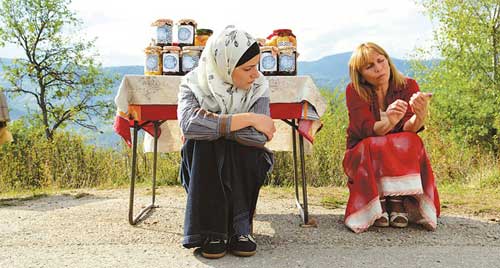
Zana Marjanovic (left) stars as Alma in Aida Begic's Snow

In an earlier post, I wrote that I wasn’t going to discuss all the films that aren’t here at Toronto, but most critics agree that this year’s lineup is unusually thin. At least when it comes to big-name directors, whether that be Hollywood prestige types like Clint Eastwood or hardcore cinephile such as Lucretia Martel. Some have blamed it on the writer’s strike, others point to the lack of quality films at Cannes and especially Venice. Of course, one doesn’t preclude the other.

That lack of high-profile films can be seen in my choices for today. While I’m excited to see both the Coen brothers and the Wavelengths program of Nathaniel Dorsky and Jean-Marie Straub, my other three films are selections I probably wouldn’t have made in previous years; they would’ve been superceded by something more interesting. Of course, that doesn’t mean they’ll necessarily be bad, and there are few things more exciting than discovering gold where you expected bronze. Would I strike gold today?

Continue Reading

⟨ Later PostsEarlier Posts ⟩