Plastic Podcast

The venerable and exceedingly intermittent Plastic Podcast, which has outlived the two blogs with which it was intertwined, and whose audio archives were difficult to ...

The Plastic Podcast

An audio program about movies. Listen with your iPod or computer.

Plastic Podcast

The venerable and exceedingly intermittent Plastic Podcast, which has outlived the two blogs with which it was intertwined, and whose audio archives were difficult to ...

Other Recent Podcasts

Feeds

Favorite Recent Tweets

via Twitter

About

Daily Plastic is a Chicago-based movie blog, a collaboration between Robert Davis and J. Robert Parks, the same pair who brought you the wearable movie tote, the razor-thin pencil pocket, and that joke about aardvarks. If you know the whereabouts of the blue Pontiac Tempest that was towed from the Plastic Parking Lot on the evening of August 7th, 2008, or more importantly if you've recovered the red shoebox that was in its trunk, please contact us at your earliest convenience.

Davis was the chief film critic for the late, great Paste Magazine (which lives on now as a website) from 2005 through 2009, and he counts this interview with Claire Denis among his favorite moments. Every once in a while he pops up on Twitter. He's presently sipping puerh in Chicago, even at this hour. Meanwhile, Parks, whose work has appeared in TimeOut Chicago, The Hyde Park Herald, and Paste, is molding unsuspecting, college-aged minds in the aforementioned windy city. Media types are warned to stay clear of his semester-sized field of influence because of the distorting effects that are likely to develop.

The © copyright of all content on Daily Plastic belongs to the respective authors.

I'll be posting quick film reactions to Twitter. Because why not? I haven't used Twitter extensively, but it's like the status feature of Facebook. Nothing more. It might work well for this sort of trickle -- don't want to hammer my Facebook friends with these.

Consider it an experiment on my part. Vials around me are bubbling, and you're welcome to sip from them with the link above. I'll also be posting here alongside J. Robert and over at Paste.

My schedule got a bit horked today for various reasons, so I've ducked into some movies I probably wouldn't have otherwise (like Cold Lunch), but I'm getting back on track.

See all of our Toronto 2008 coverage here.

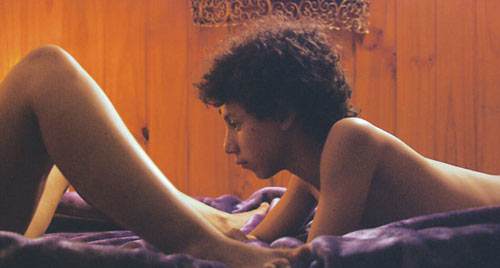
I began the festival proper with a screening of Claire Denis' new film, 35 Shots of Rum (35 Rhums). This wasn't by design, but if I could choose a way to kick off a festival, this would be it. Now if there were a way to end the festival the same way -- short of skipping three dozen movies -- my trip would be complete.

Like all of her films, this one confounds me in a good way. I have to learn how to watch each one, which is why a second viewing is so important. The music, much of it by the Tindersticks, is a hypnotic force, both in the theater and in the lives of the characters, and Denis continues her knack for finding gems at a rummage sale of discarded pop LPs. As ever in her films, dances say more than words.

But what put a surprised smile on my face was discovering that 35 Rhums is a strong homage, almost even a remake, of one of my favorite films of all time. There's an allusion to that director's movies fairly early in the film, highlighted (and, in some ways, counterposed) by a tracking shot in a doorway, but that just lays the groundwork for the plot that follows. (The list of favorite films, by the way, is due for an update, and Denis's Beau Travail will surely go onto the list, not because I hadn't seen it in 2004, but because her films grow and grow. That's how they do.)

Continue Reading

Now That’s a Provocative Image ... The Movie, Not So Much

The festival gets started on Thursday, but it’s not exactly a full day of movies. There aren’t any afternoon screenings and a relative paucity of evening ones. I suspect a lack of available theaters is to blame, but what it means is that the few available films are hot tickets. Since I always seem to have bad luck in the lottery, the result is that I rarely get an opening day ticket. On the first try, that is.

One of the things I love about TIFF is that the festival organizers usually set aside a certain number of tickets for each film’s rush line. This is where you can wait as long as you want, if you get there early enough, for however many rush tickets become available. A few minutes before the show’s about to start, the people in charge figure out how many empty seats there are, and then give that many people a chance to purchase a ticket. The first people in line obviously get the first tickets available. So if you really want to see something and you can’t get a ticket the regular way, you just have to be willing to wait in the rush line for a second chance.

Continue Reading

Abbot Gensler/Sony Pictures Classics
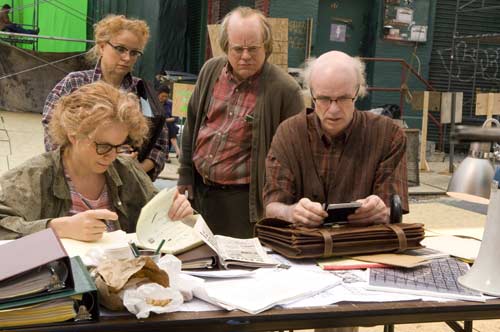
Emily Watson, Samantha Morton, Philip Seymour Hoffman, and Tom Noonan in Synecdoche, New York

Ah, Toronto. I only come once a year, and then I spend more time in dark rooms than roaming the city, but the very word ‘Toronto’ inspires anticipation and delight. For a film critic, it means a festival lasting ten days in early September, and that means movies--30, 40, even 50 of ‘em, depending on your stamina. I’ve been going six years now, and some of my favorite films of the decade are ones I saw here first: 4 Months, 3 Weeks, and 2 Days; You, the Living; Still Life/Dong; Be with Me; Tropical Malady; and Shara.

Waltz with Bashir won’t crack that list, but it’s close. It’s an animated documentary--an unusual combination--done in a style that recalls a cross between Richard Linklater’s Waking Life and certain graphic novels. Writer and director Ari Folman attempts to reconstruct what happened during the infamous 1982 Sabra and Shatila massacre. Folman was an Israeli soldier when Israel invaded Lebanon. Three months into the invasion, the Lebanese Phalangist party entered the Palestinian refugee camps and slaughtered hundreds of refugees. Whether the Israeli army was complicit in the killings has always been disputed. Israeli soldiers were surrounding the camps, but it’s unclear how much they realized of what was going on, though later an Israeli government commission found General (later Prime Minister) Ariel Sharon “personally responsible.”

Continue Reading

Stephen Vaughan / Warner Bros. Pictures

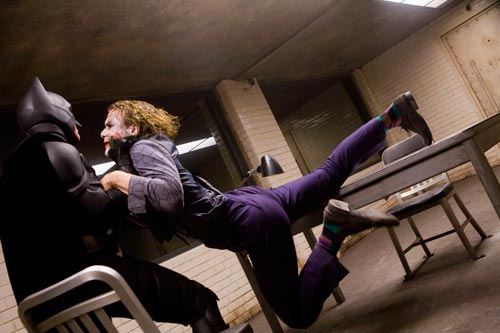
With the summer freshly in the can, we present 14 compact reactions (some more compact than others) to a season of generally loud, generally trashy movies. Picking up where our last speed round left off, we talk about The Dark Knight, WALL*E, Man on Wire, Wanted, and others. Dump the lemonade, brew a pot of something warm, and bid adieu to the summer's second half.

0:00 Intro
1:31 The Dark Knight (Nolan) [discussion]
16:07 WALL*E (Stanton)
21:44 Man on Wire (Marsh)
24:02 Baghead (Duplass & Duplass)
24:27 Encounters at the End of the World (Herzog)
27:41 Hancock (Berg)
30:11 Hellboy II: The Golden Army (Del Toro)
34:48 American Teen (Burstein) [discussion]
42:37 The Wackness (Levine)
45:19 Tell No One (Canet)
46:57 Wanted (Bekmambetov)
48:57 Get Smart (Segal)
52:01 Meet Dave (Robbins)
54:20 Gonzo: The Life and Work of Dr. Hunter S. Thompson (Gibney)
1:01:05 Outro

Continue Reading

  • When the Toronto festival draws nigh, we spend a lot of time at GreenCine Daily scanning for the words "Venice" and "Telluride," hoping to find out what to see and what to skip in Canada. In particular, we spend a good long while with Michael Sicinski's one-of-a-kind preview of the Wavelengths series of experimental films. (And, as we implied previously, we studiously avoid entries that mention Claire Denis so as to approach her films clean. I'm not hearin' nothing.)
  • You could always turn to CBS News for such coverage. Take this little article, for starters, about Natalie Portman's directorial debut, a short film that appears in New York, I Love You, a sequel of sorts to Paris, Je t'aime and a prequel to Dubuque, I Like You But Not Like That (2009) and Modesto, You're the Tops Behind Paris, New York, and Frankly Dubuque (2010). In the CBS article, two paragraphs (of eight) are about the color, shape, and density of the items that Portman was wearing and clutching. The article also says that Portman, strangely, showed no interest in talking to this clutch of reporters about her film!
  • Don LaFontaine, whose voice can be heard in thousands of movie trailers, has died. Over at Glenn Kenny's blog, Aaron Aradillas has posted some of his favorites. I like the one for the original Friday the 13th, which -- little known fact -- was first shown on a late-spring episode of Sesame Street.

Zeitgeist Films
Kim Rivers Roberts and Scott Roberts in Trouble the Water

Over Labor Day weekend, a major hurricane seems to have just missed New Orleans. But exactly three years ago, when another strong-but-not-record-breaking storm just missed New Orleans, much of the city was under water a day later. The national lack of curiosity about how and why that happened, after the arrival of a storm that was well beneath the supposed limits of the levee system, is astounding. When they speak about it publicly, government officials most often blame Mother Nature while critics of those government officials blame the lack of leadership in a time of crisis.

If you drove your car at 75 miles per hour down the highway and the wheels flew off sending your family into the ditch, you'd expect a better answer than, "Well, 75 is really fast." Or: "It's horrible that the ambulance took an hour to arrive." Yes, but. Nearly every American lives within reach of a major piece of infrastructure built by the same group who designed and built those levees, the Army Corps of Engineers. So you can even set aside compassion, if you want, and tether your inquiry to good old fashioned self-interest. Our mysterious national lethargy doesn't arise from either impulse.

Trouble the Water, a documentary by Carl Deal and Tia Lessin, exposes one small part of the tragedy and highlights the fact that the storm was just one chapter in a story that continues to this day. It's the story of Kimberly and Scott Roberts who didn't have the means to get out of New Orleans before the hurricane arrived. They rode out the storm, and the movie's buzz has centered around the footage that Kimberly shot as the water rose to the rafters of her Ninth Ward home. It's a compelling eye-witness account, even though the picture is as jerky as a video camera in a hurricane, but the footage serves mostly as the introduction to a movie whose heart lies beyond the storm and beyond New Orleans proper.

Continue Reading

It’s funny how you can read or see something, and suddenly you start noticing references that you would have completely overlooked beforehand. As I wrote a couple weeks ago, I read Howard Zinn’s provocative A People’s History of the United States this summer. Now, almost everywhere I look someone is paying tribute to Zinn or invoking his famous book.

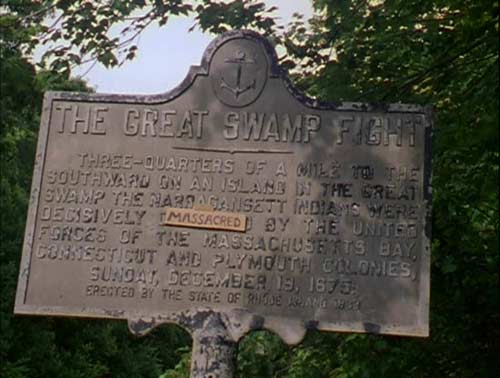
The latest example is the hour-long video Profit motive and the whispering wind (lack of capitalization is intentional). Directed by film curator and scholar John Gianvito, it explicitly echoes Zinn in its attempt to reawaken our grasp of progressive history and the heroes who blazed the trails before us. Gianvito accomplishes this by shooting gravesites and other markers of memory all over the United States. Some are tombstones of famous people: Henry Thoreau, Harriet Tubman, Cesar Chavez. Others are less well known, though history fans and readers of Zinn’s book will recognize the names of Anne Hutchinson, Daniel Shays, and Eugene Debs, among others.

Although some footage of signs detailing labor strikes and battles will inform those who don’t already come with the necessary background knowledge, Gianvito provides little context for his shots, obviously believing that merely recalling the dead will honor them and provoke the viewer to find out more. There is an implicit trust in the audience, which has inspired some critics, but I couldn’t help wondering whether most viewers (at least those not already part of the “choir”) would just find the exercise baffling and unproductive. Admittedly, there’s little of the patronization that comes with PBS documentaries, but there’s little of the information either.

Not that providing information need be a primary goal, but the movie’s formal structure is also wanting. Intercut with the 3-5-second shots of gravestones and other markers are repeated shots of nature, specifically wind blowing through the trees. Gianvito has spoken of his pantheistic perspective, but there’s little rigor to his choices. I have no idea why he chooses certain locations and times for the trees, and I fear Gianvito doesn’t, as well. And certain motifs pop up (decaying tombstones, signs of big business) only to disappear as if Gianvito had an idea but then got distracted by something else.

Several critics have invoked James Benning, but Benning’s editing is much crisper, much more intentional. A cynic might wonder if Gianvito edited his nature shots by picking them at random. I’ll admit the film creates an almost hypnotic effect as it reaches its conclusion, with the pleasant use of ambient sound washing over the audience. And it has its heart in the right place. But if you didn’t know who Sojourner Truth was (or others like her) before you came in the theater, I can’t imagine that this movie will have any impact on you.

Profit motive and the whispering wind screens at the Gene Siskel Film Center in Chicago on Thurs., Sept. 4 at 6 p.m. Gianvito will be present for a post-screening discussion.
Ari Folman and David Polonsky/Sony Pictures Classics
Ari Folman's Waltz with Bashir
In anticipation of the Toronto International Film Festival, Daily Plastic presents an exchange between the plastic proprietors, Robert Davis and J. Robert Parks.
To my esteemed colleague Mr. Parks:

The multiplex is a dead zone in August. In recent weeks we've managed to find a few films worth seeing in theaters (see the higher altitudes of the movie grid for a few), but in general it's a wasteland. You know it, I know it, and everyone brought up by decent parents knows it.

But it's coming to a close, and how can I tell? Because I'm getting excited about what's left to see this year, and here in North America, nothing kicks off the last trimester like the Toronto International Film Festival. Running from September 4-14, it showcases over 200 new films from established international masters and Hollywood hacks alike. There, in Canada, the twain shall meet and share a cup of tea.

The festival kicks off on Thursday, and we'll be blogging from the ground, but while we're waiting around, muttering, let's get the lay of the land. J. Robert, is there anything you're particularly looking forward to, or are there any films in the schedule that you can comment on today?

Before I run down the list of films I'm most eager to see, I can offer brief impressions of eight films that have already screened for press in the U.S. or have played at earlier festivals, three of which I enjoyed a great deal:

Continue Reading

Cathy Kanavy / Focus Features

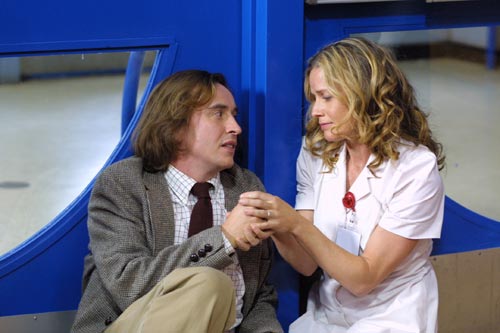
Judging by the squeals of laughter in the theater where I saw it, Hamlet 2 has some of the same appeal as Waiting for Guffman and The Producers. Steve Coogan plays a failed actor who now teaches high school drama and plans to direct the students in his own play, a nakedly autobiographical sequel to Hamlet. If you sketch the movie on vellum, with lines, boxes, arcs, and arrows, it might seem to be a functional piece of comedy: attractive, load-bearing, and fully inhabitable. The dual pleasures of a terrible amateur stage play and jokes that are obviously, intentionally offensive sound like the strong pillars of a grand arch, but when the project is actually built, it's clear from the first rain that this roof leaks like a sieve.

One reason is that the so-offensive-it's-hilarious routine requires the filmmakers to operate with a certain amount of precision. It helps to know that they aren't laughing about pedophilia and rape; they're laughing about someone whose artistic abilities are so poor that his well-meaning treatment of such issues is hideously crass. The needle is threadable, but this film's crassness isn't limited to the production staged by its characters. In one scene, an ACLU lawyer played by Amy Poehler (Saturday Night Live) mouths off to a large man and then holds him back by saying, "You want to hit me? Go ahead. I'm married to a Jew, so I got nothin' to lose!" Poehler delivers the line with enough spunk to sell almost any string of English words, but did they have to be these? I can't for the life of me figure out what's funny about equating a Jewish marriage to battery of women.

And once the film stirs its casual, unmotivated anti-Semitism into the mix, I find myself less comfortable with the jokes about incest, even though they seem to be penned by a clueless character. We already knew the character had poor judgment. Now we know the filmmakers do, too.

When it's not stabbing haphazardly toward irreverence, Hamlet 2 has the more mundane problem of not being very funny. Mild amusements -- like a guy who roller skates badly, or a guy who's trying to keep his testicles cool on doctor's orders -- are repeated until the chuckles are dead, like three cartoons tessellated on unfunny wallpaper.

The movie does have brief glimmers of inspiration: the roller skates are finally explained with a clever, almost throwaway comment; the abrasive theatre critic who seasonally trashes the teacher's productions feels like a character from Rushmore; and Catherine Keener's general attitude, like Amy Poehler's, is inherently funny even when her lines aren't.

But the only inspired touch that sustains more than a few seconds is the casting of Elisabeth Shue to play herself, a nurse in Tucson, a former actor who left the rat race because the world always needs nurses. Shue's self-deprecating performance is funny and absurd. Plus, she's right about the need for nurses. Maybe she can convince a few of her peers to follow her into the field of health care and stop signing up for dismal films that misuse their talent.

⟨ Later PostsEarlier Posts ⟩