Plastic Podcast

The venerable and exceedingly intermittent Plastic Podcast, which has outlived the two blogs with which it was intertwined, and whose audio archives were difficult to ...

The Plastic Podcast

An audio program about movies. Listen with your iPod or computer.

Plastic Podcast

The venerable and exceedingly intermittent Plastic Podcast, which has outlived the two blogs with which it was intertwined, and whose audio archives were difficult to ...

Other Recent Podcasts

Feeds

Favorite Recent Tweets

via Twitter

About

Daily Plastic is a Chicago-based movie blog, a collaboration between Robert Davis and J. Robert Parks, the same pair who brought you the wearable movie tote, the razor-thin pencil pocket, and that joke about aardvarks. If you know the whereabouts of the blue Pontiac Tempest that was towed from the Plastic Parking Lot on the evening of August 7th, 2008, or more importantly if you've recovered the red shoebox that was in its trunk, please contact us at your earliest convenience.

Davis was the chief film critic for the late, great Paste Magazine (which lives on now as a website) from 2005 through 2009, and he counts this interview with Claire Denis among his favorite moments. Every once in a while he pops up on Twitter. He's presently sipping puerh in Chicago, even at this hour. Meanwhile, Parks, whose work has appeared in TimeOut Chicago, The Hyde Park Herald, and Paste, is molding unsuspecting, college-aged minds in the aforementioned windy city. Media types are warned to stay clear of his semester-sized field of influence because of the distorting effects that are likely to develop.

The © copyright of all content on Daily Plastic belongs to the respective authors.

We here at Daily Plastic don’t plan on converting into a political blog anytime soon, but I couldn’t let the contrast between last night’s brilliant Obama speech and McCain’s perplexing vp choice go unmentioned. I’m a fervent Obama supporter (he’s my neighbor after all), but I understand why many Americans might choose McCain on Nov. 4. There are certain policy positions that people hold dear, and Obama doesn’t always match up with those. Fair enough.

But I am genuinely baffled by McCain’s pick of Gov. Sarah Palin. You stake your entire candidacy on your experience and measured judgment, and then you choose someone who hasn’t even been governor for two years? Two years?? And let’s be honest. It’s not like she’s the governor of California or Texas or some other big state. It’s Alaska, for crying out loud. I’m sure she’ll talk about the hard choices she’s made in being the hands-on manager of the state and having to balance a budget and so forth and so on, but let’s be frank. Alaska has less than 700,000 people in it. There are dozens and dozens of cities in the U.S. that are bigger than that.

What kind of foreign policy experience does she have? Well, let’s let McCain himself explain:

As the head of Alaska's National Guard and as the mother of a soldier herself, Governor Palin understands what it takes to lead our nation.

I am utterly speechless. I just don’t know how to respond. Those are her qualifications? McCain said that with a straight face??

And it’s not like this is a moot point, where the vice president doesn’t matter. McCain is an old man--if he serves out two full terms, he’ll be in his 80s. On top of that, he’s had health issues in the past. The possibility of the vice president having to take over for McCain at some point is real, and Sarah Palin is who we want in that position? Even Republicans have to be a little nervous. I know I am.

If nothing else, this should assuredly end all that crap about whether Obama is experienced enough. Palin makes Obama look like the second coming of FDR.
Warner Bros. Pictures

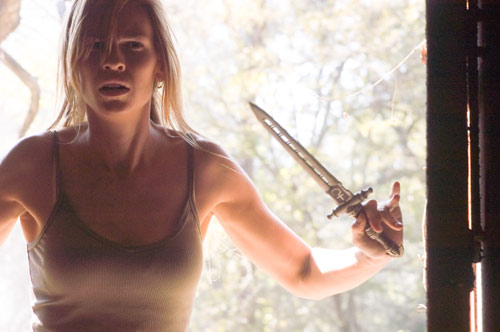
In The Reaping, Hillary Swank goes to a swampy town in the South to investigate some weird paranormal-type happenings. It's what she does. She's a professional certified scientific debunker.

Gets there. Snoops around. Sees some pretty plagueish occurrences of unclear scientific basis, including a river that has run red with goop and coughed up all manner of dead frogs and livestock. Even Swank and her team of rubber-booted scientists are gagging on the stench, but they gather their samples like pros and send them to the lab for analysis. Check for blood, boys. Let's see what's makin' this thing all red.

Now, the movie has lots of jolts and gross-outs up to this point, but for me it's not yet scary. However, it will be. After gathering their samples, the team retires for the evening at an old house near the river. Crickets chirp. Or cicadas. Whatever. Some Southern bug. The scientists shoot the breeze. They fire up the grill for some dinner and relaxation, and a local guy throws some grub over the coals. Plague or no plague, a team of debunkers has gotta eat. "What's cooking?" they ask the griller. And he says, "Fish."

Gulp. The team pauses. The film pauses. Its heart skips a beat. Reaction shot. Reaction shot. Reaction shot. F-f-f-fish?

Continue Reading

  • August is the month that filmmakers trade instruments with the people who run the Tony Awards. It's a big hoot, and the members of the participants' respective guilds look forward to it every year. This year, Zhang Yimou (Raise the Red Lantern, Hero) designed the opening of the Beijing Olympics, Ken Burns and Steven Spielberg are dancing Monday and tonight, respectively, at the DNC, and -- here's where I get a little confused -- Slavoj Žižek is directing the Telluride Film Festival which begins Friday. Cuh-razy, man.
  • Telluride is odd among the fall festivals -- among all film festivals, actually -- in that it announces its lineup, dramatically, on the day it opens. In the meantime, we can busy ourselves with news from San Sebastian and Venice. Daily Plastic will be reporting from the Toronto festival next week, and since there's a fair bit of overlap across the major August-September festivals, we're following remote dispatches closely.
  • We'd point you to the Sydney Morning Herald's overview of the Venice festival, but since they say that Claire Denis' last film "was a slasher," they're disqualified from contention. Even if they mean Trouble Every Day, that was seven years and three feature films ago. And her design for an unusually bloody Tony Awards never saw the light of day, so you can't count that, either.


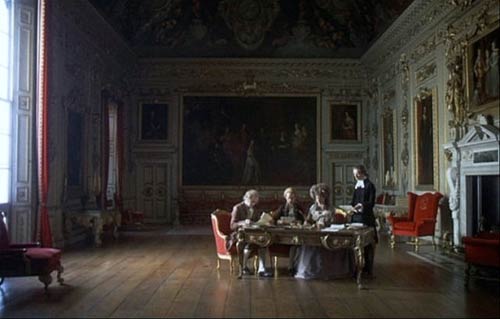
Last month, the British film magazine Sight & Sound presented an entertaining feature on dream double bills, asking various writers to describe a provocative or fun hypothetical pairing of movies. It goes without saying that this inspired bloggers galore. I’ve never been particularly good at that kind of parlor game, though it’s always fun to play. Last week, however, I stumbled by chance upon a particularly interesting double feature. I had the opportunity to experience Stanley Kubrick’s Barry Lyndon for the first time and then, a few hours later, followed that up by seeing the new Brideshead Revisited feature.

Things They Have in Common, of Which There Are a Surprising Number
  • Both are set in the past and use the past as a subject. Although their settings are 150 years apart, they resemble each other more than Brideshead resembles our own time, especially in how class completely dominates interpersonal relations.
  • Both take relish in the spectacularly opulent use of castles and estates to signify wealth and impress the viewer.
  • Both are costume dramas. The costumes for Barry Lyndon are especially fancy, but great care has obviously been used in creating the post-Edwardian fashion of Brideshead.
  • Both use a voiceover. In Barry Lyndon, it’s a droll, sometimes ironic omniscient narrator, while in Brideshead Revisited, it’s the main character, Charles Ryder, looking back on his life.
  • Both are about strivers, men hoping to raise their class position. Both succeed by marrying much richer women. In neither case does it end well.
  • Both are about painting. Let’s start there.

Continue Reading

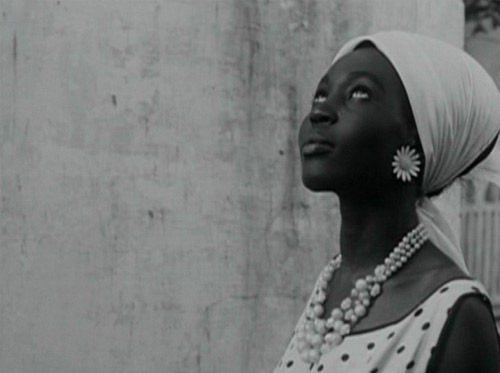
Jonathan Rosenbaum writes briefly on his site about Ousmane Sembène's first film, La noire de... (aka Black Girl), and mentions one of the confusing details of its history. I believe I have a bit of information to add.

The film was made in 1966, but I first saw it a few years ago in Toronto with Sembène in attendance. At the time, I didn't realize there were multiple versions of the film -- nothing was said about this at the screening, and I hadn't read anything about it online -- so I didn't take care to write down certain details that I now wish I could recall. But my fairly clear memory of the film is that it starts in Senegal. A young woman who lives there accepts an offer from a French family and leaves her relatives and friends to work in Antibes in the south of France. There's a long series of neighborhood good-byes and good-lucks. When she arrives in France, as she rides in a car from the airport to the apartment where she will live and work (as domestic help), the countryside is shown briefly in color. The rest of the film is in black and white, including the remainder of her increasingly grim days in France.

Now, when you watch this film on DVD or see the film in a retrospective, you won't see the color sequence. (As an aside: I mistakenly mentioned the color sequence in a capsule review of the DVD in Paste, because the magazine's long lead-times required me to write the review before the DVD was finished.)

The lack of this color sequence has been written about sporadically on the web -- Rosenbaum mentions it here and previously here -- usually by referring to a printing issue with the DVD, i.e. the wrong film stock was used to print the color sequence.

But I've seen no mention of a more drastic change. I was shocked to see that the DVD from New Yorker Films begins not in Senegal but Antibes with the French family. It then jumps to the girl in Senegal and picks up where I remember the film beginning. It's entirely possible that my memory is faulty, but since my understanding of the film revolves around the girl's first impression of her exciting French adventure (and the audience's, since the film is told entirely from her perspective), I don't think the version I saw began in France at all.

Since I know of no way to see the version that I saw in Toronto, I've never been able to compare it side-by-side with the commonly available one, but I'm fairly certain there are two major differences: her arrival in Antibes is in color and the structure of the film is markedly different.

Mysteries, mysteries.

Robert Murphy
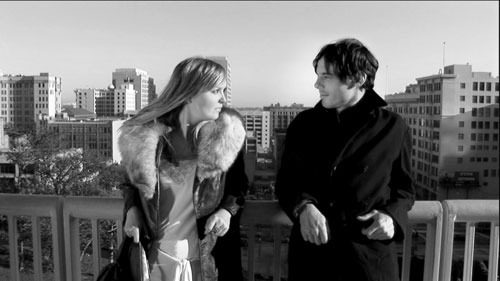
Sara Simmonds and Scoot McNairy in In Search of a Midnight Kiss

“Misanthrope seeks misanthrope” is the craigslist personals ad that Wilson, a screenwriter recently arrived in L.A., places the day before New Year’s Eve. Vivian is the blonde, unemployed starlet who answers his ad and bullies him into a date just hours before the clock strikes midnight. In Search of a Midnight Kiss is the movie that follows these two cynical but hopeful romantics through the streets of Los Angeles. It has the problems that afflict many an indie dramedy, but it also captures a certain vibe that’s winning and affecting.

The film does not start well. Our protagonist (played by Scoot McNairy in an adequate performance) is caught masturbating in the living room ... to a photoshopped nude picture of his roommate’s girlfriend ... and he’s caught by the roommate who finds the situation more comical than creepy ... and the girlfriend finds it “sweet.” Hmmm.

There are other moments in the film that don’t ring true. At one point Wilson and Vivian stand on an empty proscenium stage improvising a play. I don’t need to tell you that the skit is their cute way of working out their relationship. But writer/director Alex Holdridge must think he’s got something special, because the scene drags on and on.

Yet much of the movie has a different ring, of authenticity. I’ve only spent three days in L.A., but this movie is how I imagine the place to be. Despite the film’s low budget, the black-and-white street cinematography (courtesy of Robert Murphy) is well used, and Holdridge creates a sense of place that’s critical to the subtle desperation both Wilson and Vivian feel. And while some of the dialogue falls flat (it’s not clear whether the script or the lack of retakes is to blame), other scenes have a quiet power. I particularly like a morning-after sequence, as two people try to figure out what happens next.

Even in low-budget films, the actresses are usually attractive, a reminder that there are an awful lot of beautiful women struggling to make it in Hollywood. Fortunately, Sara Simmonds is more than a pretty face. She gives a standout performance as the brash but ultimately vulnerable Vivian. The chemistry she finds with McNairy builds as the movie closes in on midnight, with both leads beautifully conveying the emptiness that loneliness can bring. The secondary characters aren’t quite as interesting, and the story gives way too much time to Vivian’s hysterically angry ex-boyfriend. But when it’s just Wilson and Vivian trying to make it till “Auld Lang Syne,” I was happy to root for ‘em.

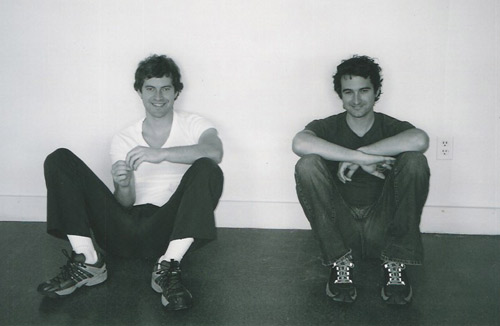
Mark and Jay Duplass, writers and directors of Baghead

Arrogant smarty-pants might guess that this first edition of the Plastic Podcast is no different from its predecessor, the Errata Movie Podcast. But if we've learned anything from the movies, it's that know-it-alls will always receive their comeuppance. If you think you're a know-it-all, please wait around the corner for what's coming to you.

The Duplass brothers, Mark and Jay, may feign ignorance at times, but their new movie Baghead is plenty smart. Mixing genres in clever ways, it even inspires chills through the hoariest of horror cliches, the cabin in the woods. We sat down with the brothers Duplass in an exceedingly warm Chicago conference room, and the conversation revolved around the process of writing and editing, why watching movies at night is a different experience, and the enduring classic that is Fletch.

One last note. We here at Daily Plastic were only slightly miffed that the man in the woods is wearing a paper bag on his head, but we've gotten over it.

0:00 Intro
2:51 Interview: Mark and Jay Duplass
6:54 - Planning for Improvisation
10:58 - Working with Professional Actors
12:28 - Whittling the Footage
14:05 - Staying Ahead of the Audience
17:05 - Audience Dynamic, Permission to Laugh
21:11 - Obsessed with Plot
22:45 - Division of Labor
23:56 - Influences and Future Directions
29:10 - What sort of movies does the world need now?
30:38 Outro

A few fun quotations from the interview:

Continue Reading

Howard Zinn’s A People’s History of the United States was first published in 1980 and has inspired in some people a fanatical devotion we don’t normally associate with a 700-page history book. Songs, movies, and plays have all been dedicated to Zinn and his work, and a documentary co-written by Zinn based on the book will premiere at this year’s Toronto International Film Festival.

A People’s History is a conscious attempt to provide a different kind of historical record. As Zinn writes early on:

If history is to be creative, to anticipate a possible future without denying the past, it should, I believe, emphasize new possibilities by disclosing those hidden episodes of the past when, even if in brief flashes, people showed their ability to resist, to join together, occasionally to win.

The resistance Zinn refers to involves how people throughout U.S. history have stood against the forces of power--the moneyed elite, government, business--and tried to construct a fairer, more equitable system. A country in which the system worked for the common man instead of the other way around.

It’s amazing how different a history this is. The moving of armies, the electing of presidents, the “great men” of national leadership get only a few lines. Instead the emphasis is on workers and labor unions, women and African Americans, Native Americans and immigrants as they struggle for better and fairer conditions.

Continue Reading

Merie Weismiller Wallace/DreamWorks
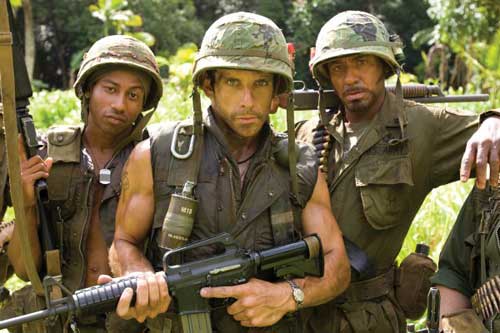
Brandon T. Jackson, Ben Stiller, and Robert Downey, Jr. in Tropic Thunder

Comedies these days lack explosions and firearms, but Judd Apatow and Ben Stiller are on the job. Apatow's Pineapple Express and Stiller's Tropic Thunder, which have arrived in theaters during the dog days of August, are action-comedy hybrids that follow genre conventions even as they poke gentle fun at them. As a low-budget affair, Baghead, also in theaters, adds modestly-funded terror instead of top-dollar napalm to its comedy, but it too is a hybrid. Genres are back in vogue among hip young filmmakers, with rubrics so nice, they've followed them twice.

Very funny and very frivolous, Tropic Thunder is a big movie about making a big movie. Ben Stiller, Robert Downey Jr., and Jack Black star as actors shooting a Vietnam war film in the jungle. The film-within-the-film has a British director, played by Steve Coogan, who's in over his head, but the producer, played by Tom Cruise under heavy makeup, is turning the screws. He barks orders and spews invective over a video link from California, determined to whip this movie into the can. Desperate to comply, the emasculated director takes the radical step of 1) planting digital cameras in the jungle's trees and 2) dropping his stars in the middle of nowhere, with their costumes, fake guns, and a script outline. His last-ditch effort is to shoot their improvisations guerilla style.

The setup reads like the parody of a well-known piece of moviemaking folklore, one that's retold like a war story: the massive production beaten by the jungle. Francis Coppola's Apocalypse Now and Werner Herzog's Fitzcarraldo are as famous for their schedule overruns, uncontrollable stars, and maniacal directors as they are for the final products. Consequently, their associated behind-the-scenes documentaries -- Hearts of Darkness about Coppola's adventure and Burden of Dreams about Herzog's -- are as fascinating as the films themselves, and maybe more.

But Tropic Thunder's satire isn't so lofty. It's down in the undergrowth, skewering certain Hollywood personality types using the folklore as a frame. Critics have collectively tied themselves into knots trying to measure how close the movie comes to crossing various lines of good taste, but more interesting than whether it causes offense is how carefully, or carelessly, Stiller and company navigate a minefield of stereotypes. They're walking on eggshells one minute and riding roughshod the next.

Continue Reading

⟨ Later PostsEarlier Posts ⟩